 May 10 / 2026
On the morning of May 4, 2026, Tamil Nadu’s political establishment woke up to a result that no establishment poll, no veteran commentator, and no back-room operator had truly prepared for. A party that did not exist two years ago had just beaten the DMK and the AIADMK, two parties that have, between them, held a monopoly over Tamil Nadu’s government since 1967 and done so on its very first attempt at the ballot box.
Tamilaga Vettri Kazhagam won 108 seats. The DMK won 59. The AIADMK won 47. TVK captured over 38% of the popular vote, 14 percentage points more than either Dravidian giant. The voter turnout hit 85.1%, the highest in the state’s modern history. And almost every exit poll, staffed by professionals paid to read exactly this electorate, had placed TVK somewhere between 10 and 30 seats.
The gap between prediction and result is not just embarrassing. It is a diagnosis. It tells you that every political analyst, every journalist, and every intelligence agency in this state was reading a room that had already rearranged itself and refused to see it.
From Screen to Stage: The Journey of Thalapathy Vijay
To understand how this happened, you have to understand who Vijay is and more importantly, who he chose not to be, for a very long time.
Joseph Vijay Chandrasekhar debuted as a child actor in 1984, took his first lead role at 18, and spent the next three decades becoming one of Tamil cinema’s most bankable stars. Blockbusters like Ghilli (2004), Thuppakki (2012), Mersal (2017), Bigil (2019), and Master (2021) cemented his commercial dominance and made him “Thalapathy” (meaning “Commander”) to a devoted fan base that stretched across generations and geographies.
But Vijay was conspicuously absent from politics for most of this time, conspicuously, because in Tamil Nadu, cinema and politics have always been intertwined. M.G. Ramachandran made the leap. Jayalalithaa made the leap. Kamal Haasan tried and stumbled. Yet Vijay stayed quiet, letting his films do the talking except for some occasional political statements. Mersal (2017) had dialogue that directly attacked GST policy; BJP leaders demanded cuts and the film became a political flashpoint. Sarkar (2018) took on voter fraud and corrupt politicians so explicitly that the AIADMK, then in power, demanded scenes be deleted. Kaththi (2014) went after corporate water theft and agrarian distress. Film after film, Vijay embedded political messaging into mass entertainment but with restraint from the actual politics.
That restraint was, as it turns out, deeply strategic.
In 2009, he quietly organised his fan clubs, reportedly numbering around 85,000 across Tamil Nadu, under the Vijay Makkal Iyakkam, or “Vijay’s People Movement.” His fan welfare organisation contested local body elections in 2021 and won 115 of the 169 seats it entered. These were signals, not announcements.
Then, on February 2, 2024, Vijay made it official. He announced the formation of Tamilaga Vettri Kazhagam, declared his intent to contest the 2026 state elections, formally retired from acting, and walked out of cinema; the highest-paid Tamil actor of his era to enter the most uncertain arena of all.
The Long Game: How TVK Built Its Foundation
What followed was two years of disciplined, almost military organisation. TVK’s first major political conference in Vikravandi in October 2024 drew over 800,000 people, a staggering number for a party that was barely eight months old. At that conference, Vijay defined the party’s ideology: secular social justice, egalitarianism, a two-language policy, and democracy. He named the BJP an “ideological opponent” and the DMK a “political adversary,” deftly positioning TVK as the clean alternative to both.
In February 2025, TVK launched an enrollment drive aimed at appointing over 70,000 booth-level agents, the critical ground-level layer that wins or loses Indian elections. They restructured the internal hierarchy, trained local leaders, and went door to door while the established parties assumed their legacy bases would hold.
When Vijay released his manifesto in March 2026, it was pointed and youth-facing: a drug-free Tamil Nadu, job guarantees, collateral-free education loans, startup funding, and monthly financial assistance to students. These weren’t vague promises. They were coded messages to a demographic that had grown up watching Vijay stand up for the ordinary man on screen and now wanted to see it off-screen too.
TVK contested alone in all 234 constituencies, a bold, some said reckless, gamble. No alliance cushion. No fallback. They won 108 seats and roughly 35% of the popular vote.
The Factors That Turned the Tide
Anti-incumbency and fatigue. Tamil Nadu voters were tired. The DMK had been in power since 2021, and people were fed up with corruption stories and the feeling that politics was just being passed around within the same families. The AIADMK wasn’t doing much better; the party was fighting within itself. People desperately wanted someone new and credible. TVK showed up at exactly the right time.
The youth vote. A huge number of young and first-time voters turned out this election 85.1%, the highest Tamil Nadu has ever seen. That number tells you that people who had never bothered to vote before actually came out. A lot of them came out for Vijay. He was someone they had grown up watching, someone who talked about jobs, education costs, and building a better future, things that actually mattered to them.
Vijay’s clean image. Tamil Nadu politics is full of old baggage, corruption cases, family dynasties, decades of the same faces. Vijay had none of that. No past scandals (except the most recent one), no family political machine, no skeletons. Being a complete outsider, which should have been a weakness, turned out to be his biggest strength. In 2026, voters didn’t want experience. They wanted clean.
The “peak of career” moment and why people believed him. Perhaps the single most emotionally powerful card in Vijay’s entire campaign wasn’t a policy promise. It was a personal statement he returned to, again and again: that he left cinema at its absolute peak not after a flop, not after relevance had faded, but when he was still Tamil Nadu’s highest-paid actor with blockbusters to his name. In post-poll conversations, this point came up repeatedly among voters as a primary reason they trusted him. The logic was simple and deeply Tamil: a man who had everything, and chose to give it up for them, must actually mean it. Politicians typically enter public life when they need it. Vijay entered it when he didn’t. That single fact made people trust him in a way no speech could have achieved. First-time voters especially said this was the moment they stopped being sceptical and decided to give him a chance.
The film as amplifier. One of Vijay’s films got stuck in CBFC delays right in the middle of the campaign. Vijay said publicly that the delays were deliberate that the establishment was trying to silence him. Whether that was true or not, it kept him in the news for weeks and made him look even more like someone the system was afraid of.
The campaign that sounded like a film. Vijay’s campaign speeches didn’t sound like typical political talk. They sounded like film dialogues; short, punchy, emotional lines that his fans had been hearing in theatres for 30 years. That was entirely on purpose. For millions of his voters, there was never much of a gap between Vijay the actor and Vijay the man. His on-screen character the guy who always stood up for ordinary people, never bowed to the corrupt, and always won in the end was exactly the image he was projecting on stage. When he attacked dynasty politics, it felt like a climax scene. When he promised a clean government, fans felt like they had already watched this movie and knew how it ended. The campaign met voters where they already were, emotionally. And that is an extraordinarily hard thing to manufacture but for Vijay, it was simply who he already was to people.
The Brains Behind the Blockbuster: The Strategists Who Made It Possible
Winning 108 seats in a debut election doesn’t happen on star power alone. Behind every political upset is a team of architects who mapped the terrain, built the machine, and managed the narrative.
The most prominent name to emerge from TVK’s inner circle is Kapil Sahu, a political consultant with over a decade of experience across nine Indian states. Sahu’s résumé includes campaigns for the INC, AAP, and the Sikkim Democratic Front, and he has worked directly with two Chief Ministers and a Deputy Chief Minister. He and a team of 12 veterans who departed IPAC (I-PAC, the political consultancy co-founded by Prashant Kishor) after the successful Delhi campaign led TVK’s electoral strategy from the ground up.
Another notable name is John Arokiasamy, TVK’s Chief Election Strategist and the man widely credited as a pivotal architect of this historic win. Appointed through his firm JPAC Persona, John joined TVK in 2024 and took charge of designing the party’s entire communication plan, with a sharp focus on reaching youth and minority voters, built around themes of inclusive governance, fresh leadership, and social reform. For TVK, he didn’t just run a campaign, he built a political identity from scratch for a brand new party in under two years, and made it stick when it mattered most.
The role of Prashant Kishor, India’s most celebrated political strategist was murky but notable. When Vijay launched TVK in early 2024, he reportedly held meetings with Kishor. Kishor publicly predicted that Vijay stood “a very good chance” of winning Tamil Nadu and then publicly denied being a political adviser, calling himself “a friend.”
The work of the strategists was thorough: narrative engineering to position Vijay as the anti-establishment reformer, grassroots mobilization in districts where TVK had no legacy presence, and political intelligence to identify vulnerable constituencies where splits in the DMK-AIADMK vote could deliver surprise victories.
Without this level of professional strategic architecture, 108 seats would have been impossible. Star power gets you crowds. Booth agents, data analytics, narrative control, and crisis management get you governments.
What This Means for the Future: The Social Media Election
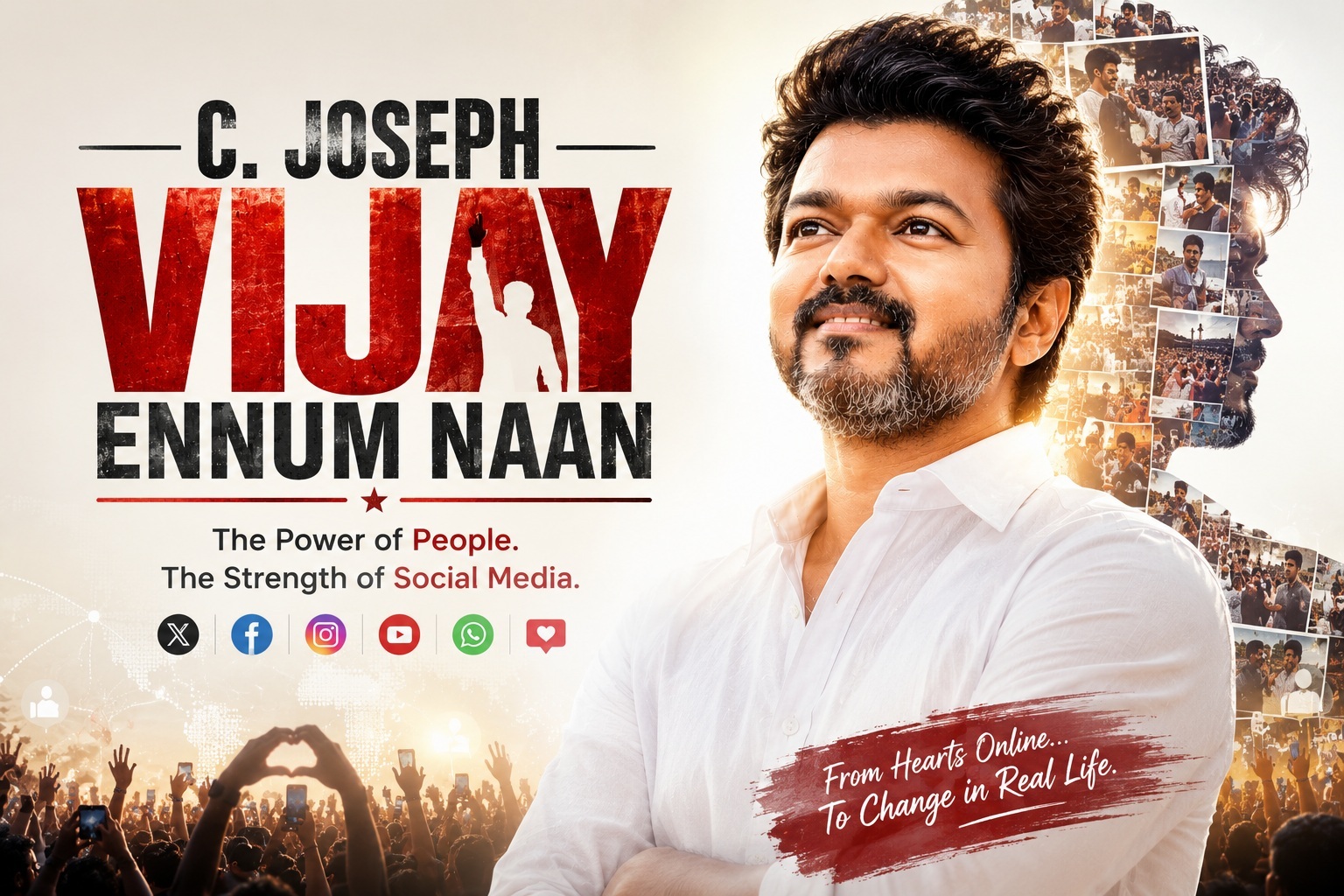
TVK’s victory is a landmark in the evolving relationship between social media and political power in India.
Vijay’s fanbase did not merely vote, they organised, amplified, and mobilised online in ways that traditional media could not track or counter. Decades of parasocial connection between Thalapathy and millions of Tamil households meant that when TVK posted content, it spread not because of paid promotion alone but because of genuine emotional investment. Fan networks that had spent years sharing film clips and celebration posts pivoted effortlessly into political communication pipelines.
Even after the victory became evident, the tense period between May 5 – 9, when Vijay was expected to formally prove the majority, revealed something even more powerful: the depth of public emotional involvement. While Vijay maintained his characteristic silence, social media was flooded with voices speaking on his behalf, including many people who had never actively engaged in politics before.
The 85.1% turnout is the data point that matters most here. That number suggests that social media reached voters who traditional political outreach hadn’t, first-time voters, rural youth with smartphones, urban migrants following events in real time. The barriers between cinema celebrity and political authority have always been thin in Tamil Nadu, but social media dissolved them entirely.
Going forward, no Tamil Nadu politician or indeed any Indian politician targeting a young electorate can ignore the lesson: the algorithm is now a constituency, and whoever commands emotional attention online commands votes offline.
What Businesses Can Learn from the TVK Playbook
Vijay’s electoral campaign was, in many ways, a masterclass in brand-building under pressure and the corporate world would do well to take notes.
Start with a community before you launch a product. TVK didn’t build its voter base in 2026. It spent 15 years cultivating it through fan clubs, welfare organisations, and local body wins. By the time the party formally launched, the distribution network already existed. Businesses that invest in community before they pitch a product consistently outperform those that try to build both simultaneously.
Position against, not just for. TVK didn’t just promise good governance. It named its opponents ideological and political and gave voters a clear enemy narrative alongside an aspirational one. In marketing terms, knowing who you are not is as powerful as knowing who you are.
Know exactly who you are talking to. TVK didn’t try to win everyone. The manifesto was sharply focused on young voters jobs, education loans, and startup funding, drug-free communities. They identified who their core voter was and spoke directly to that person. Businesses that try to appeal to everyone usually end up resonating with no one. Pick your customer clearly. Speak to them specifically. Let the campaign feel personal, not broadcast.
Timing is a strategy, not an accident. Vijay entered politics at a specific moment when both the DMK and AIADMK were at low points and voters were actively looking for an alternative. He waited until the market was ready. Product timing works exactly the same way. A great product launched into a market that isn’t ready will fail. The same product launched when frustration with existing options has reached a peak will fly. Reading the room; whether it’s an electorate or a market is one of the most valuable and most undervalued skills in business.
Crisis management is brand management. The Karur tragedy could have ended TVK. The response swift, personal, financially accountable, transformed a crisis into a credibility moment. How you respond to negative reviews says more about your brand than anything you planned.
Hire professionals for what you don’t know. Vijay understood cinema. He did not pretend to understand electoral strategy. Bringing in specialists like Kapil Sahu and John Arokiasamy’s team was an act of strategic humility that paid enormous dividends. Too many founders and business leaders hire people for the areas they are already strong in and try to figure out their blind spots themselves. The smarter move is the opposite. Know what you don’t know and bring in the best people for exactly that.
And that last point, knowing what you don’t know might be the most important lesson of all. Vijay had the fame, the trust, and the vision. But he was smart enough to know that wasn’t enough. He brought in the right people to fill the gaps, and that combination of star power and professional strategy is what made the difference between a good attempt and a historic win.
The same is true for your business. You may have a great product, a great story, and genuine passion. But navigating today’s digital landscape, the algorithms, the content strategy, the community building, the brand positioning is its own kind of expertise. You don’t have to figure it out alone.
That’s exactly where LBN Tech Solutions comes in…
We help businesses cut through the noise; building digital strategies that don’t just generate likes but build real, lasting relationships with the right audience. Whether you’re a new brand trying to make your first mark or an established business that feels invisible online, we understand the full picture: the content, the community, the messaging, and the timing.
Because if a first-time politician with a two-year-old party can defeat giants who have ruled for six decades, simply by showing up smarter online, imagine what the right digital strategy can do for your business.
Let’s build something people actually believe in. Reach out to LBN Tech Solutions today here.
Questions Everyone Is Asking About Vijay and TVK
1. How did Vijay’s TVK win the 2026 Tamil Nadu election?
TVK combined strong booth-level organization, youth-focused promises, and emotional public trust in Vijay’s image. The campaign also used social media and grassroots mobilization effectively across the state.
2. Why did young voters support Vijay and TVK?
Many young voters connected with Vijay’s focus on jobs, education loans, startups, and clean governance. His decision to leave cinema at its peak also made voters believe he was serious about public service.
3. What role did social media play in TVK’s victory?
TVK’s fan networks transformed into digital campaign communities that amplified speeches, videos, and political messaging rapidly. This helped the party reach first-time and young voters more effectively than traditional campaigns.
4. Why was Vijay seen as different from traditional politicians?
Vijay entered politics without a family political background or major corruption allegations. His outsider image and long-standing connection with ordinary people through cinema created a strong sense of trust.
5. Who were the strategists behind TVK’s election success?
TVK worked with experienced political strategists like Kapil Sahu and John Arokiasamy, who helped build booth networks, communication strategies, and targeted voter outreach across Tamil Nadu.
6. What business lessons can be learned from TVK’s campaign?
The campaign showed the importance of community building, clear audience targeting, emotional branding, timing, and hiring the right experts to execute strategy effectively.
7. Why did Vijay’s TVK become successful so quickly?
TVK succeeded by combining Vijay’s strong public trust with youth-focused messaging, grassroots organization, and highly effective digital campaigning.
Categories
- Listings, Reviews, Mentions: Which Signal Matters Most to AI?
- Ads in ChatGPT: What They Are, How They Work, and What It Means for Small Businesses
- Can AI Recommendations Be Manipulated? What Small Business Owners Need to Know in 2026
- The AI Content Overload Problem: How Smart Brands Win Without Posting More in 2026
- The AI Layer of Social Media: What’s Really Happening Behind Every Scroll
- Reddit Marketing 101: An Intro to the Platform
- LLMs.txt and Google Search: What Marketers Really Need to Know in 2026
- Can AI Content Rank on Google? Myths, Facts, and New Updates in 2026
- Schema Markup: The Hidden Signal Helping Content Rank, Get Cited, and Show Up in AI Overviews
- AI Overview Optimisation: The New Frontier of SEO (and How We’re Winning It)
- Zero-Click Searches and Their Impact on Content Writing and Blogging Services
- From Keywords to Intelligence: The SEO–AI Evolution by 2026
- Is SEO Really Dead, or Has It Simply Evolved into Fuel for AI?
- The “See It, Want It, Buy It” Loop: How Fast Decision Cycles Are Quietly Rewriting Marketing (And What Small Businesses Must Do Now)
- Why Monthly Newsletters Still Work (And How to Make Yours Stand Out)
- The Ultimate Guide to Content Repurposing – The Underrated SEO Factor
- How Does Video Content Help Improve SEO?
- Top 12 Reasons Why Your Website Needs a Blog Corner
- Difference Between Copywriting and Content Writing
- Content Marketing – A Modern Guide for 2023
- What Is the Difference Between Content Marketing and Content Strategy?
- How to Write Compelling Headlines in 3 Steps
- Marketing in the Attention Economy: Why Capturing Attention Is Harder Than Ever (And What Smart Businesses Are Doing About It)
- Google Kills &num=100: Good or Bad for SEO?
- Brand Loyalty – Why Does It Matter and How to Build It?
- 5 Ways to Convert Your Visitors into Customers
- How to start a digital marketing agency from scratch and run it successfully? | Part 2
- How to start a digital marketing agency from scratch and run it successfully? | Part 1
- Digital marketing tips for preschool owners
- What are brand pillars, and why do they matter?
- How to Get the Results You Want Through Your Digital Marketing Plan?
- Demystifying the Debate Around Influencer Marketing (How to Do It Correctly)
- How to Use Customer Service as an Online Marketing Strategy
- The Importance of Commenting in Forums for SEO
- What Is Moltbook? All Your Questions Answered About the Strange New Social Media for AI
- 4 Digital Marketing Incidents Everyone’s Talking About: Outages, Scams, Malware & Analytics Chaos
- Google Algorithm Updates – March 2024
- Google Ranking Algorithm Updates – February 2024
- Top Search Engine Marketing Tools to Use to Save Time and Money – Part 2
- Google Ranking Algorithm Updates – September & October 2023
- Top Search Engine Marketing Tools to Use to Save Money and Time – Part 1
- Google Ranking Algorithm Updates – August 2023
- Google Ranking Algorithm Updates – July 2023
- Google Ranking Algorithm Updates – June 2023
- Google Ranking Algorithm Updates – May 2023
- 10 Cool Things You Could Do with ChatGPT
- ChatGPT Is at Capacity Now – How to Fix This Error?
- ChatGPT – Is It the Future or Just the Latest AI Fad?
- 5 Ways Technology Might Be Blocking Your Business Progress
- Trends That May Shape the Future of Digital Marketing
- The Significance of Meta Description in 2024
- What are the 9 basic rules Google follows for Featured Snippets?
- What is agile marketing?
- How will Core Web Vitals enhance SEO in 2024?
- Digital Marketing Trends for 2024
- What Are the Major Elements of an Ideal E-Commerce Website?
- Ecommerce Website: Benefits, Working and Development Process
- Choosing the Right E-Commerce Web Development Company: A Comprehensive Guide
- E-Commerce Site Search – Best Practices to Increase Conversion (Part – 2)
- E-Commerce Site Search – Best Practices to Increase Conversion (Part – 1)
- What Is E-Commerce Merchandising and How Can It Help Improve Sales?
- Top 5 Reasons Why Your Business Needs a Website in 2023
- How to Write a Product Description for eCommerce Websites
- Types of Ad Fraud and Invalid Traffic: A Complete Guide for Businesses
- Meta Andromeda Explained: Why Small Brands Need to Rethink Meta Ads Now
- Google’s New ‘Sponsored Results’ Update – What Businesses Should Know Now
- How to Create a Demand Generation Campaign in Google Ads
- Demystifying Demand Gen Ads: Understanding the Power of Awareness and Engagement
- Why Is Search Engine Marketing Important?
- Google Ads Checklist for 2024
- Difference between Organic and Paid Search Results
- Essential Rules and Strategies for Effective Healthcare Content Marketing
- Healthcare’s Content Revolution: Statistics and Strategies for Reaching Today’s Patients
- Healthcare Marketing: Loyalty-Building Techniques and Basic Healthcare Marketing Content Ideas
- The Essential Guide to Content Marketing for Modern Healthcare Organizations
- Healthcare Marketing through the Ages: The Vital Role of Digital Transformation
- Setup GA4, Search Console & Tag Manager with Expert Help from LBN Tech Solutions
- Get Found on Facebook, Instagram, X, and LinkedIn – Professionally Set Up by Experts
- Brand Yourself with Every Email – The Power of a Custom Email Signature by LBN
- Why You Need a Domain and Branded Email – Even Without a Website
- The Pareto Principle of SEO: Why Small Businesses Should Stop Trying to Fix Everything at Once
- 9 Beginner Mistakes Most Small Businesses Make in SEO
- 11 Actionable On-Page SEO Factors You Need to Know
- Cracking the Code: Mastering On-Page SEO for Website Excellence
- Off-Page SEO – Best Short-Term and Long-Term Strategies to Employ
- Off-Page SEO Ranking Factors That Everyone Should Know About
- Off-Page SEO – What Is It and How Can You Get the Best Out of It?
- Top 5 SEO Mistakes to Avoid
- What to Expect from a Professional SEO Company?
- What is the Role of SEO in the Web Design/Development Process?
- Is Trying To Rank SEO without an SSL (HTTPS) Pointless?
- How We Brought Down the Bounce Rate from 93% to 5% (Case Study)
- How to Rank Higher on Voice Searches
- The ‘Proof Loop’: How Customers Cross-Check Businesses Before Choosing You
- Best AI Tools for Small Business Marketing in 2026: The Complete Guide for Owners Who Are Tired of Being Outspent
- 11 Reasons Why Having an E-commerce Website Is More Important Than Ever
- 5 Mobile Marketing Techniques That Can Grow Your Business
- Lead Generation Basics for Small Business Owners
- How to Conduct a Competitive Analysis?
- How to Win Social Media Without Posting Daily
- How TVK won Tamilnadu in 2026: The strategy, the story and the business lessons
- Empowering Women in Digital Marketing: Job Opportunities, Career Paths, and Top Interview Questions Answered
- How to Market using Social Media for Different Generations
- Tips to Handle Digital Branding Like an Expert
- WhatsApp Ads Decoded: Everything You Must Know About This Marketing Game Changer
- Digital Marketing vs. Digital Branding – What’s the Difference?
- Website vs. Social Media: Is a Website Still Necessary for a Business?
- What Should Small Businesses Post on Social Media? (A Complete Guide)
- The making of the first ever Digital Women Economic Forum
- Schema Markup: The Hidden Signal Helping Content Rank, Get Cited, and Show Up in AI Overviews
- Schema Mark-up in SEO: A Guide to Types, Benefits, and Importance
- How to Track Website Calls and Email Clicks in GA4 Using Google Tag Manager
- How to Set Up Google Tag Manager: A Step-by-Step Guide
- What is Google Tag Manager? How does it work and what are the Benefits of using Google Tag Manager?
- The Ultimate Guide to Profile Page Structured Data
- Mastering Schema Markup: Unravelling the Secrets of Schema, Supported Formats, and Implementation
- Reasons Why Google May Penalize Your Website
- Mobile-First Design vs. Responsive Design – What’s the Difference in 2026?
- Top 10 CMS Platforms for Website Design and Blogging
- Website Redesign Mistakes to Avoid – Professional Website Redesign Services
- 10 Clear Signs Your Website Needs a Redesign and Why It’s a Smart Investment
- The Importance of UI/UX Design in Web Development
- What Are the Phases Involved in Web Development?
- A Beginner’s Guide to Web Development
- What Is CMS and How Can It Be Used in Website Development?
- Why Should You Consider Redesigning Your Website?
- What Is the Process of Web Design and How Does It Differ from DIY Solutions?
- Web Design Trends of 2026 – What Small Businesses Need to Know
Well narrated, great understanding and discription of the background. Wishing Vijay a successful tenure as the new Chief Minister of Tamil Nadu.
Congrats to Vijay!