 Apr 28 / 2026
What Are Ads in ChatGPT?
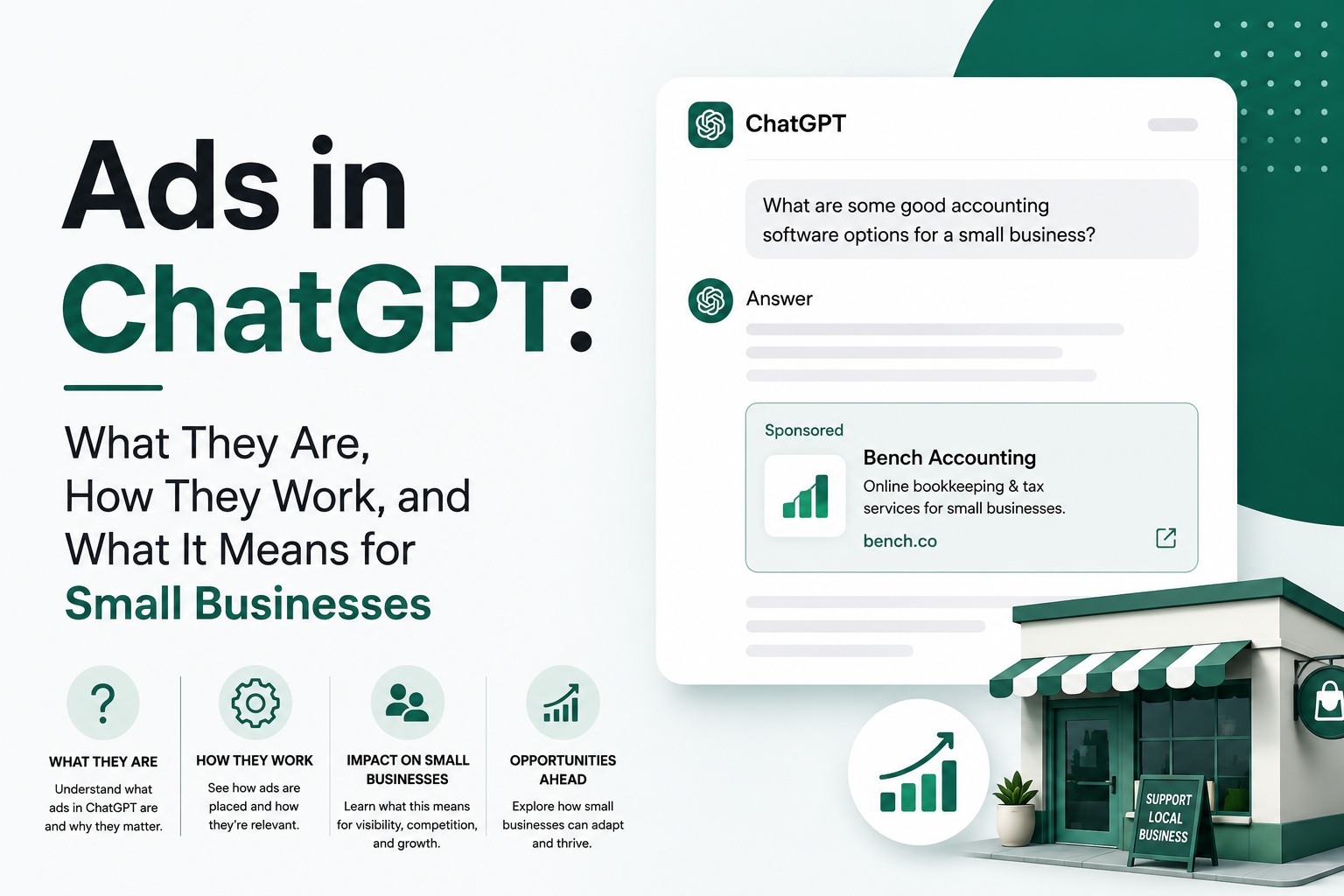
Ads in ChatGPT refer to sponsored content placements that may appear with AI-generated responses. Currently in a pilot phase in the United States, this rollout is limited and carefully separated from core responses.
Unlike traditional banner ads or pop-ups, these ads are:
Think of them less like Google display ads and more like smart recommendations placed next to answers.
How Do Ads in ChatGPT Work?
At a high level, ads in ChatGPT operate on three core principles:
- Contextual Relevance
Ads are matched to the user’s query.Example:
This is similar to search intent advertising, but powered by conversational AI.
- Separation from Core Response
Ads are not embedded inside the AI’s answer.Instead:
This distinction is critical for trust.
- Platform-Controlled Delivery
According to OpenAI’s public statements and product behaviour:
Current Status of Ads in ChatGPT (2025–2026)
Here’s what’s actually happening right now:
This is important. The ad system is:
Why This Matters for Small Businesses
This isn’t just another ad channel.
It’s potentially the first real shift in search behaviour since Google.
Instead of:
“Search → Click → Browse”
We’re moving toward:
“Ask → Get Answer → Act”
That changes everything about visibility.
How Do People Feel About Ads in ChatGPT?
This is where things get interesting.
We analyzed discussions across Reddit threads and tech communities to understand real user sentiment.
What Do People Feel About This? (Pulled from Reddit Discussions)
- “This Was the Last Clean Place on the Internet”
One of the most repeated sentiments isn’t anger-it’s disappointment.
“One of the reasons I enjoy using ChatGPT is how clean it is. No ads…”
Users don’t just see ChatGPT as a tool.
They see it as an escape from the ad-heavy internet.
What this means:
This is fundamentally different from platforms like Google or Instagram, where ads were expected from day one.
- The Biggest Fear: “Will This Corrupt the Answers?”
This is the #1 concern. “Hosting ads means… bias in the output responses.”
Even though OpenAI clearly states ads won’t affect answers, users are sceptical. And honestly, history gives them reasons to be. There is also the problem of recommendations through subtle persuasions in conversations.
A recent industry analysis shows companies are already trying to influence AI outputs through content manipulation and “AI SEO” tactics.
Why users are worried:
This is classic “platform trust erosion anxiety.”
- “It Starts Small… Then It Gets Ugly”
Users aren’t reacting to current ads.
They’re reacting to what ads usually become.
“If ads are just the beginning?”
This pattern is well-known:
- Ads start minimal
- Platform scales
- Monetisation increases
- UX degrades
We’ve seen it with:
- The “Helpful vs Manipulative” Line
This is where things get subtle and powerful.
Some users are actually open to ads… but only under one condition:
Ads must feel like useful recommendations, not interruptions.
But research shows a dangerous tension here:
A controlled study found:
That’s a paradox:
This is the core UX challenge of AI advertising.
- Privacy Concerns: “Are You Listening to Me… Too Closely?”
This is the second major anxiety layer.
Even with official assurances:
Users are still uneasy.
Why?
Because ChatGPT conversations are:
Academic research on Reddit discussions shows:
Ads amplify this fear:
“If you can target ads… how much do you know about me?”
- “If I’m Paying, I Better Not See Ads”
This one is blunt and non-negotiable.
When rumours surfaced about ads appearing for paid users:
This creates a two-tier trust system that platforms must maintain carefully.
- “This Was Inevitable… But Still Disappointing”
Not all reactions are negative.
Some users are surprisingly pragmatic:
“Seeing ads is a reasonable price for free use.”
Others go even further:
“Nowhere is safe from ads.”
This group sees ads as:
- Emotional Reactions: Stronger Than Expected
Some reactions go beyond logic into emotion:
“The death of ChatGPT.”
“Mostly garbage ad-riddled results.”
This tells us something important: Users are emotionally invested in AI tools more than they ever were in search engines.
- A Deeper Psychological Layer (Backed by Research)
Academic analysis of Reddit discussions reveals broader concerns about AI:
Another study highlights risks like:
Now add ads into that mix… It’s not just about marketing anymore. It’s about influence over human thinking.
So, What Are Users Really Saying?
If you strip everything down, the sentiment looks like this:
Acceptable if:
Not acceptable if:
LBN Tech Solutions
As AI platforms like ChatGPT reshape how people discover and trust information, the brands that adapt early will lead the conversation, not chase it. Navigating this shift requires more than just visibility; it demands credibility, strategy, and precision. That’s where we come in, helping businesses stay ahead with future-ready digital marketing that’s built for both humans and AI. Contact us here and let us figure this out together.
FAQs
1. Are ads currently shown inside ChatGPT answers?
No. Ads are shown as separate, clearly labelled sponsored elements and do not alter the AI-generated response.
2. Who sees ads in ChatGPT?
Primarily users on free or lower-tier plans. Paid users typically experience an ad-free environment.
3. Do ads influence ChatGPT’s answers?
No. OpenAI maintains a separation between ad delivery systems and response generation.
4. Can small businesses advertise in ChatGPT?
As of now, access is limited and not fully open like Google Ads. However, this is expected to evolve into a broader advertising platform.
5. Is ChatGPT becoming a search engine competitor?
Yes, ChatGPT and similar AI tools are increasingly replacing traditional search journeys, especially for informational and decision-based queries.
Summary
Ads in ChatGPT mark a major shift from traditional search-driven marketing to AI-led discovery, where answers, not links, drive decisions. While the current rollout is limited and carefully separated from responses, user reactions reveal a mix of curiosity, cautious acceptance, and deep concerns around trust, bias, and privacy. The biggest takeaway? People are open to ads but only if they remain transparent, relevant, and non-intrusive. For small businesses, this signals a new opportunity to get discovered inside AI conversations, not just search engines. As this space evolves, success will depend on balancing visibility with credibility in a trust-first ecosystem.
Categories
- Listings, Reviews, Mentions: Which Signal Matters Most to AI?
- Ads in ChatGPT: What They Are, How They Work, and What It Means for Small Businesses
- Can AI Recommendations Be Manipulated? What Small Business Owners Need to Know in 2026
- The AI Content Overload Problem: How Smart Brands Win Without Posting More in 2026
- The AI Layer of Social Media: What’s Really Happening Behind Every Scroll
- Reddit Marketing 101: An Intro to the Platform
- LLMs.txt and Google Search: What Marketers Really Need to Know in 2026
- Can AI Content Rank on Google? Myths, Facts, and New Updates in 2026
- Schema Markup: The Hidden Signal Helping Content Rank, Get Cited, and Show Up in AI Overviews
- AI Overview Optimisation: The New Frontier of SEO (and How We’re Winning It)
- Zero-Click Searches and Their Impact on Content Writing and Blogging Services
- From Keywords to Intelligence: The SEO–AI Evolution by 2026
- Is SEO Really Dead, or Has It Simply Evolved into Fuel for AI?
- The “See It, Want It, Buy It” Loop: How Fast Decision Cycles Are Quietly Rewriting Marketing (And What Small Businesses Must Do Now)
- Why Monthly Newsletters Still Work (And How to Make Yours Stand Out)
- The Ultimate Guide to Content Repurposing – The Underrated SEO Factor
- How Does Video Content Help Improve SEO?
- Top 12 Reasons Why Your Website Needs a Blog Corner
- Difference Between Copywriting and Content Writing
- Content Marketing – A Modern Guide for 2023
- What Is the Difference Between Content Marketing and Content Strategy?
- How to Write Compelling Headlines in 3 Steps
- Marketing in the Attention Economy: Why Capturing Attention Is Harder Than Ever (And What Smart Businesses Are Doing About It)
- Google Kills &num=100: Good or Bad for SEO?
- Brand Loyalty – Why Does It Matter and How to Build It?
- 5 Ways to Convert Your Visitors into Customers
- How to start a digital marketing agency from scratch and run it successfully? | Part 2
- How to start a digital marketing agency from scratch and run it successfully? | Part 1
- Digital marketing tips for preschool owners
- What are brand pillars, and why do they matter?
- How to Get the Results You Want through Your Digital Marketing Plan?
- Demystifying the Debate Around Influencer Marketing (How to Do It Correctly)
- How to Use Customer Service as an Online Marketing Strategy
- The Importance of Commenting in Forums for SEO
- What Is Moltbook? All Your Questions Answered About the Strange New Social Media for AI
- 4 Digital Marketing Incidents Everyone’s Talking About: Outages, Scams, Malware & Analytics Chaos
- Google Algorithm Updates – March 2024
- Google Ranking Algorithm Updates – February 2024
- Top Search Engine Marketing Tools to Use to Save Time and Money – Part 2
- Google Ranking Algorithm Updates – September & October 2023
- Top Search Engine Marketing Tools to Use to Save Money and Time – Part 1
- Google Ranking Algorithm Updates – August 2023
- Google Ranking Algorithm Updates – July 2023
- Google Ranking Algorithm Updates – June 2023
- Google Ranking Algorithm Updates – May 2023
- 10 Cool Things You Could Do with ChatGPT
- ChatGPT Is at Capacity Now – How to Fix This Error?
- ChatGPT – Is It the Future or Just the Latest AI Fad?
- 5 Ways Technology Might Be Blocking Your Business Progress
- Trends That May Shape the Future of Digital Marketing
- The Significance of Meta Description in 2024
- What are the 9 basic rules Google follows for Featured Snippets?
- What is agile marketing?
- How will Core Web Vitals enhance SEO in 2024?
- Digital Marketing Trends for 2024
- What Are the Major Elements of an Ideal E-Commerce Website?
- Ecommerce Website: Benefits, Working and Development Process
- Choosing the Right E-Commerce Web Development Company: A Comprehensive Guide
- E-Commerce Site Search – Best Practices to Increase Conversion (Part – 2)
- E-Commerce Site Search – Best Practices to Increase Conversion (Part – 1)
- What Is E-Commerce Merchandising and How Can It Help Improve Sales?
- Top 5 Reasons Why Your Business Needs a Website in 2023
- How to Write a Product Description for eCommerce Websites
- Types of Ad Fraud and Invalid Traffic: A Complete Guide for Businesses
- Meta Andromeda Explained: Why Small Brands Need to Rethink Meta Ads Now
- Google’s New ‘Sponsored Results’ Update – What Businesses Should Know Now
- How to Create a Demand Generation Campaign in Google Ads
- Demystifying Demand Gen Ads: Understanding the Power of Awareness and Engagement
- Why Is Search Engine Marketing Important?
- Google Ads Checklist for 2024
- Difference between Organic and Paid Search Results
- Essential Rules and Strategies for Effective Healthcare Content Marketing
- Healthcare’s Content Revolution: Statistics and Strategies for Reaching Today’s Patients
- Healthcare Marketing: Loyalty-Building Techniques and Basic Healthcare Marketing Content Ideas
- The Essential Guide to Content Marketing for Modern Healthcare Organizations
- Healthcare Marketing through the Ages: The Vital Role of Digital Transformation
- Setup GA4, Search Console & Tag Manager with Expert Help from LBN Tech Solutions
- Get Found on Facebook, Instagram, X, and LinkedIn – Professionally Set Up by Experts
- Brand Yourself with Every Email – The Power of a Custom Email Signature by LBN
- Why You Need a Domain and Branded Email – Even Without a Website
- The Pareto Principle of SEO: Why Small Businesses Should Stop Trying to Fix Everything at Once
- 9 Beginner Mistakes Most Small Businesses Make in SEO
- 11 Actionable On-Page SEO Factors You Need to Know
- Cracking the Code: Mastering On-Page SEO for Website Excellence
- Off-Page SEO – Best Short-Term and Long-Term Strategies to Employ
- Off-Page SEO Ranking Factors That Everyone Should Know About
- Off-Page SEO – What Is It and How Can You Get the Best Out of It?
- Top 5 SEO Mistakes to Avoid
- What to Expect from a Professional SEO Company?
- What is the Role of SEO in the Web Design/Development Process?
- Is Trying To Rank SEO without an SSL (HTTPS) Pointless?
- How We Brought Down the Bounce Rate from 93% to 5% (Case Study)
- How to Rank Higher on Voice Searches
- Best AI Tools for Small Business Marketing in 2026: The Complete Guide for Owners Who Are Tired of Being Outspent
- 11 Reasons Why Having an E-commerce Website Is More Important Than Ever
- 5 Mobile Marketing Techniques That Can Grow Your Business
- Lead Generation Basics for Small Business Owners
- How to Conduct a Competitive Analysis?
- How to Win Social Media Without Posting Daily
- How TVK won Tamilnadu in 2026: The strategy, the story and the business lessons
- Empowering Women in Digital Marketing: Job Opportunities, Career Paths, and Top Interview Questions Answered
- How to Market using Social Media for Different Generations
- Tips to Handle Digital Branding Like an Expert
- WhatsApp Ads Decoded: Everything You Must Know About This Marketing Game Changer
- Digital Marketing vs. Digital Branding – What’s the Difference?
- Website vs. Social Media: Is a Website Still Necessary for a Business?
- What Should Small Businesses Post on Social Media? (A Complete Guide)
- The making of the first ever Digital Women Economic Forum
- Schema Markup: The Hidden Signal Helping Content Rank, Get Cited, and Show Up in AI Overviews
- Schema Mark-up in SEO: A Guide to Types, Benefits, and Importance
- How to Track Website Calls and Email Clicks in GA4 Using Google Tag Manager
- How to Set Up Google Tag Manager: A Step-by-Step Guide
- What is Google Tag Manager? How does it work and what are the Benefits of using Google Tag Manager?
- The Ultimate Guide to Profile Page Structured Data
- Mastering Schema Markup: Unravelling the Secrets of Schema, Supported Formats, and Implementation
- Reasons Why Google May Penalize Your Website
- Mobile-First Design vs. Responsive Design – What’s the Difference in 2026?
- Top 10 CMS Platforms for Website Design and Blogging
- Website Redesign Mistakes to Avoid – Professional Website Redesign Services
- 10 Clear Signs Your Website Needs a Redesign and Why It’s a Smart Investment
- The Importance of UI/UX Design in Web Development
- What Are the Phases Involved in Web Development?
- A Beginner’s Guide to Web Development
- What Is CMS and How Can It Be Used in Website Development?
- Why Should You Consider Redesigning Your Website?
- What is the Process of Web Design and How Does It Differ from DIY Solutions?
- What are the Newest Trends in Website Design?