 Oct 09 / 2026
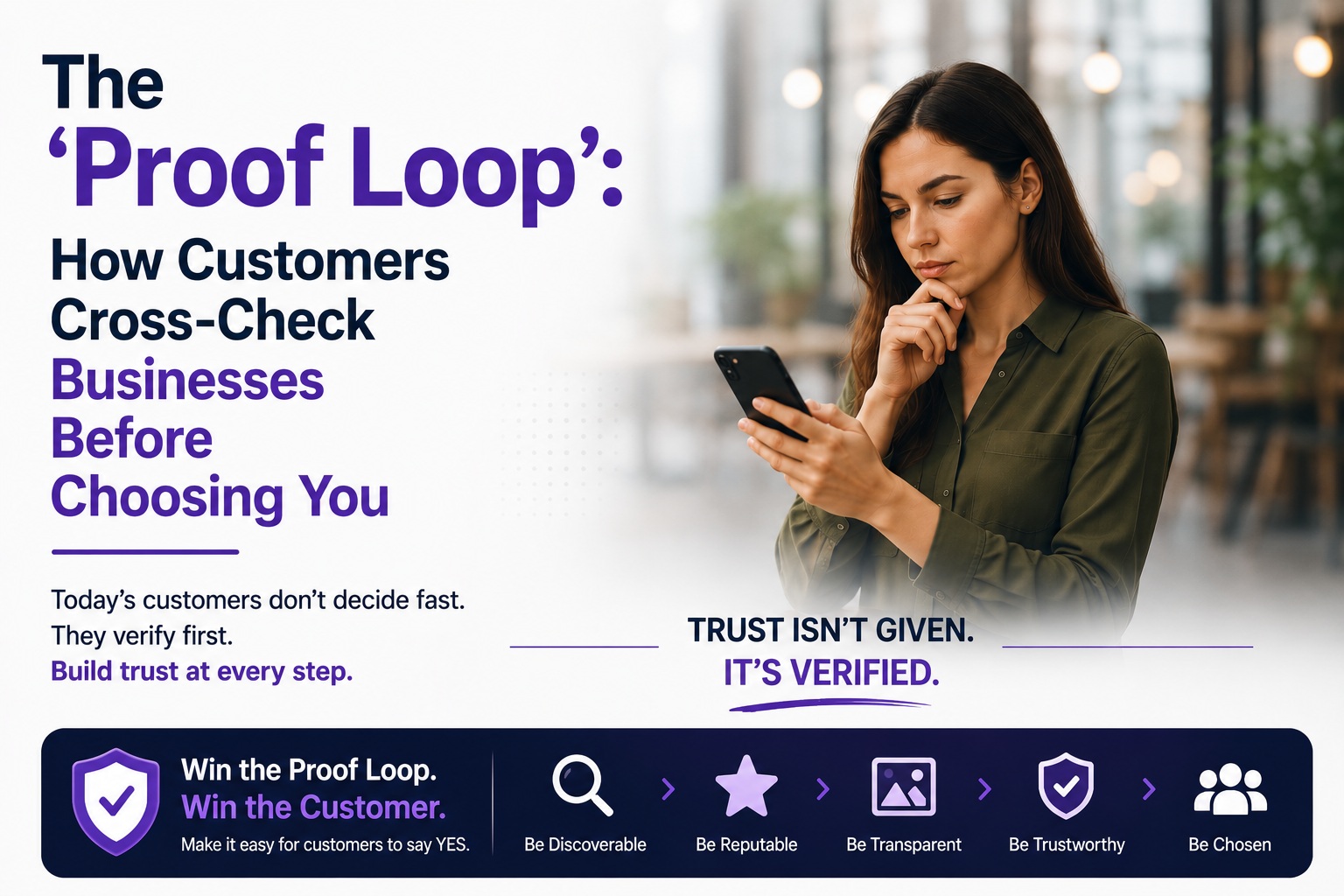
What Is the Proof Loop?
The proof loop is the private, invisible verification spiral every modern consumer runs before they trust a business with their time or money.
Before buying, booking, or meeting someone new, nearly half of Americans say they always investigate first, using tools like review sites, background searches, or social media sleuthing.
This isn’t irrational paranoia. It’s the predictable result of consumers navigating an internet flooded with deepfakes, AI-generated fake reviews, and impersonation scams. The stakes are immediate: 69% of the people who were surveyed said that they had rejected a purchase or avoided creating an account on a website that seemed unsafe.
That’s not just a lost sale. It’s a customer who wanted to buy from you, but couldn’t find enough proof to feel safe, and left.
The 6 Stages of the Proof Loop
Based on a synthesis of Google’s Zero Moment of Truth (ZMOT) research, Bright Local’s Local Consumer Review surveys, Clutch’s 2026 buyer behaviour report, and consumer neuroscience findings, the proof loop follows a consistent pattern. Think of each stage in the following procedure as a checkpoint your potential customer must clear before reaching a purchase decision.
Stage 1: The Trigger: A stimulus (an ad, a referral, a social post) creates initial curiosity. This is precisely what Google called the “zero moment of truth” (ZMOT) in their landmark 2011 research. The consumer hasn’t committed. They’ve merely been sparked. What happens next is entirely outside your control, unless you’ve prepared for it.
Stage 2: The Google Name Search: Almost universally, the first active move is typing your business name into Google. What appears on that first page is your instant reputation report card, visible to a stranger in under 3 seconds. 74% of consumers won’t move forward with a purchase if they see negative content within the first page of search results.
Stage 3: The Star Rating Gate: The star rating is a filter, not a final decision. Consumers use it as a binary pass/fail checkpoint. 72% of consumers will not consider products rated below four stars. Only 15% of consumers trust star ratings alone. The rating gets them in the door. The reviews close the deal.
Stage 4: The Deep Review Read: Most consumers form an opinion after reading 1 to 6 reviews. They’re seeking authenticity rather than perfection. Research shows a realistic mix of positive and slightly negative reviews is trusted more than an implausible wall of 5-star ratings. A business that responds professionally to criticism earns disproportionate trust at this stage.
Stage 5: The Social & AI Cross-Check: This is the newest and most rapidly evolving stage. 29% of Americans have utilised AI systems to judge a brand’s trustworthiness. Gen Z uses TikTok for the same purpose. Your business is being judged on platforms and by algorithms you don’t control but can still influence.
Stage 6: The Website Trust Scan: Your website is where the showdown happens. 74% of consumers say a reliable website or app will increase their trust in an online business. They’re scanning for contact information, SSL security, professional design, and fresh content, all within about 15 seconds. A slow, outdated, or confusing website can nullify every positive signal from the previous five stages.
What Converts and What Doesn’t
Trust signals that convert:
Trust killers:
The asymmetry is unforgiving. It takes 2x as many good online experiences to build trust as it takes bad ones to break it. And Americans tell an average of 15 people about poor service experiences compared to only 11 people about good experiences.
The AI Factor: How ChatGPT Is Now Vetting Your Business
Here is the most disruptive shift in the proof loop since the rise of Yelp: AI-powered credibility audits.
ChatGPT and other similar tools have been used by around 1 out of 3 Americans to determine the reliability of a business. So, you aren’t being judged just by your website anymore; you are also being evaluated by AI platforms that you cannot control, but whose answers you can shape through the information available about your brand.
Unlike a traditional Google search, where you have meaningful control over SEO, AI models like ChatGPT, Google Gemini, and Perplexity synthesise information from across the web and deliver confident summaries that feel authoritative to the consumer. If your business has poor reviews, thin content, or inconsistent directory information, that’s exactly what the AI will tell your potential customer, with no rebuttal option on your part.
This is the new frontier of answer engine optimisation (AEO) and generative engine optimisation (GEO), which involves structuring your online presence so AI models can find, understand, and accurately represent your business when consumers ask about you.
Why Reputation Management Is Not Optional
A peer-reviewed study published in the Journal of Small Business Strategy in 2026 found that online reputation management explained 35% of the variance in small business performance. That means more than a third of why some small businesses outperform their competitors comes down to reputation management, excluding product quality, pricing, or location.
Business owners who do not respond to reviews earn 9% less revenue on average. Conversely, responding to all reviews can increase purchase probability by 88%.
Frequently Asked Questions
What is the proof loop in digital marketing?
The proof loop is the multi-step verification process consumers go through before choosing a business. It typically follows six stages: encountering a trigger (ad, referral, or social post), running a Google name search, checking the star rating, reading detailed reviews, cross-checking on social media and AI tools, and scanning the business website. 96% of consumers check reviews before buying a product or service they haven’t tried. Businesses that optimise each stage see measurably higher conversion rates and revenue.
How do consumers cross-check businesses before buying?
Consumers use an average of six review sites before choosing a business. They combine these with Google searches, social media profiles, the business’s own website, and increasingly, AI tools like ChatGPT. 29% of Americans have used AI-based tools to assess a brand’s credibility. The process is largely invisible to the business and happens entirely before any customer contact is made.
How many reviews does a small business need to be trusted?
A business that has a minimum of 200 reviews earns double what its competitors earn. The average local business has 39 Google reviews. The three most important factors are recency (83% of consumers say reviews must be recent), authenticity (a realistic mix of ratings outperforms a suspicious wall of perfect 5-stars), and business responsiveness. There is a significant competitive gap here that attentive small businesses can close quickly.
Does responding to reviews actually help small businesses increase revenue?
Yes. Businesses that respond to at least 25% of their reviews average a 35% higher conversion rate overall. Responding to all reviews can increase purchase probability by 88%. And only about 5% of businesses respond to their reviews, despite 89% of consumers expecting a response, making this one of the highest-ROI, lowest-competition growth actions available to small business owners today.
Can a single negative review lose customers for a small business?
Yes, even one negative review appearing on the first search results page can cost a business 22% of its possible customers, while a minimum of 3 negative reviews can result in a loss of 59% of potential customers. The critical response is not to avoid all negative reviews but to respond professionally and promptly. 97% of consumers will read a business’s response to a negative review before making their final decision.
How can small businesses optimise for AI-powered search and answer engines in 2026?
To appear credibly in AI-generated answers, small businesses should: maintain an accurate, detailed Google Business Profile; publish an FAQ page with direct, structured answers; implement Local Business schema markup; accumulate genuine reviews with detailed text; publish consistent fresh content; and ensure business information is identical across all online platforms. This is known as answer engine optimisation (AEO) or generative engine optimisation (GEO). Businesses that embrace this in 2026 will build a compounding advantage as AI-driven discovery accelerates.
What star rating do consumers require before choosing a small business?
The practical minimum is 4.0 stars. 72% of consumers will not consider products rated below four stars. 52% of consumers look for an average rating of at least 4/5 stars when researching a local business. A perfect 5.0 average with no negative reviews can paradoxically reduce trust. Consumers are increasingly aware of fake review manipulation and are more comfortable with businesses that have a realistic, slightly imperfect rating profile paired with professional responses to criticism.
LBN Tech Solutions
The proof loop never sleeps, and neither should your digital presence. Every unanswered review, every outdated webpage, and every missing trust signal is quietly costing you customers you never even knew you had. At LBN Tech Solutions, we help small businesses close those gaps fast, starting from reputation management and review strategy to conversion-focused web design that passes every stage of the proof loop with flying colours. Ready to turn your digital presence into your best salesperson? Let’s talk here.
Categories
- Listings, Reviews, Mentions: Which Signal Matters Most to AI?
- Ads in ChatGPT: What They Are, How They Work, and What It Means for Small Businesses
- Can AI Recommendations Be Manipulated? What Small Business Owners Need to Know in 2026
- The AI Content Overload Problem: How Smart Brands Win Without Posting More in 2026
- The AI Layer of Social Media: What’s Really Happening Behind Every Scroll
- Reddit Marketing 101: An Intro to the Platform
- LLMs.txt and Google Search: What Marketers Really Need to Know in 2026
- Can AI Content Rank on Google? Myths, Facts, and New Updates in 2026
- Schema Markup: The Hidden Signal Helping Content Rank, Get Cited, and Show Up in AI Overviews
- AI Overview Optimisation: The New Frontier of SEO (and How We’re Winning It)
- Zero-Click Searches and Their Impact on Content Writing and Blogging Services
- From Keywords to Intelligence: The SEO–AI Evolution by 2026
- Is SEO Really Dead, or Has It Simply Evolved into Fuel for AI?
- The “See It, Want It, Buy It” Loop: How Fast Decision Cycles Are Quietly Rewriting Marketing (And What Small Businesses Must Do Now)
- Why Monthly Newsletters Still Work (And How to Make Yours Stand Out)
- The Ultimate Guide to Content Repurposing – The Underrated SEO Factor
- How Does Video Content Help Improve SEO?
- Top 12 Reasons Why Your Website Needs a Blog Corner
- Difference Between Copywriting and Content Writing
- Content Marketing – A Modern Guide for 2023
- What Is the Difference Between Content Marketing and Content Strategy?
- How to Write Compelling Headlines in 3 Steps
- Marketing in the Attention Economy: Why Capturing Attention Is Harder Than Ever (And What Smart Businesses Are Doing About It)
- Google Kills &num=100: Good or Bad for SEO?
- Brand Loyalty – Why Does It Matter and How to Build It?
- 5 Ways to Convert Your Visitors into Customers
- How to start a digital marketing agency from scratch and run it successfully? | Part 2
- How to start a digital marketing agency from scratch and run it successfully? | Part 1
- Digital marketing tips for preschool owners
- What are brand pillars, and why do they matter?
- How to Get the Results You Want Through Your Digital Marketing Plan?
- Demystifying the Debate Around Influencer Marketing (How to Do It Correctly)
- How to Use Customer Service as an Online Marketing Strategy
- The Importance of Commenting in Forums for SEO
- What Is Moltbook? All Your Questions Answered About the Strange New Social Media for AI
- 4 Digital Marketing Incidents Everyone’s Talking About: Outages, Scams, Malware & Analytics Chaos
- Google Algorithm Updates – March 2024
- Google Ranking Algorithm Updates – February 2024
- Top Search Engine Marketing Tools to Use to Save Time and Money – Part 2
- Google Ranking Algorithm Updates – September & October 2023
- Top Search Engine Marketing Tools to Use to Save Money and Time – Part 1
- Google Ranking Algorithm Updates – August 2023
- Google Ranking Algorithm Updates – July 2023
- Google Ranking Algorithm Updates – June 2023
- Google Ranking Algorithm Updates – May 2023
- 10 Cool Things You Could Do with ChatGPT
- ChatGPT Is at Capacity Now – How to Fix This Error?
- ChatGPT – Is It the Future or Just the Latest AI Fad?
- 5 Ways Technology Might Be Blocking Your Business Progress
- Trends That May Shape the Future of Digital Marketing
- The Significance of Meta Description in 2024
- What are the 9 basic rules Google follows for Featured Snippets?
- What is agile marketing?
- How will Core Web Vitals enhance SEO in 2024?
- Digital Marketing Trends for 2024
- What Are the Major Elements of an Ideal E-Commerce Website?
- Ecommerce Website: Benefits, Working and Development Process
- Choosing the Right E-Commerce Web Development Company: A Comprehensive Guide
- E-Commerce Site Search – Best Practices to Increase Conversion (Part – 2)
- E-Commerce Site Search – Best Practices to Increase Conversion (Part – 1)
- What Is E-Commerce Merchandising and How Can It Help Improve Sales?
- Top 5 Reasons Why Your Business Needs a Website in 2023
- How to Write a Product Description for eCommerce Websites
- Types of Ad Fraud and Invalid Traffic: A Complete Guide for Businesses
- Meta Andromeda Explained: Why Small Brands Need to Rethink Meta Ads Now
- Google’s New ‘Sponsored Results’ Update – What Businesses Should Know Now
- How to Create a Demand Generation Campaign in Google Ads
- Demystifying Demand Gen Ads: Understanding the Power of Awareness and Engagement
- Why Is Search Engine Marketing Important?
- Google Ads Checklist for 2024
- Difference between Organic and Paid Search Results
- Essential Rules and Strategies for Effective Healthcare Content Marketing
- Healthcare’s Content Revolution: Statistics and Strategies for Reaching Today’s Patients
- Healthcare Marketing: Loyalty-Building Techniques and Basic Healthcare Marketing Content Ideas
- The Essential Guide to Content Marketing for Modern Healthcare Organizations
- Healthcare Marketing through the Ages: The Vital Role of Digital Transformation
- Setup GA4, Search Console & Tag Manager with Expert Help from LBN Tech Solutions
- Get Found on Facebook, Instagram, X, and LinkedIn – Professionally Set Up by Experts
- Brand Yourself with Every Email – The Power of a Custom Email Signature by LBN
- Why You Need a Domain and Branded Email – Even Without a Website
- The Pareto Principle of SEO: Why Small Businesses Should Stop Trying to Fix Everything at Once
- 9 Beginner Mistakes Most Small Businesses Make in SEO
- 11 Actionable On-Page SEO Factors You Need to Know
- Cracking the Code: Mastering On-Page SEO for Website Excellence
- Off-Page SEO – Best Short-Term and Long-Term Strategies to Employ
- Off-Page SEO Ranking Factors That Everyone Should Know About
- Off-Page SEO – What Is It and How Can You Get the Best Out of It?
- Top 5 SEO Mistakes to Avoid
- What to Expect from a Professional SEO Company?
- What is the Role of SEO in the Web Design/Development Process?
- Is Trying To Rank SEO without an SSL (HTTPS) Pointless?
- How We Brought Down the Bounce Rate from 93% to 5% (Case Study)
- How to Rank Higher on Voice Searches
- The ‘Proof Loop’: How Customers Cross-Check Businesses Before Choosing You
- Best AI Tools for Small Business Marketing in 2026: The Complete Guide for Owners Who Are Tired of Being Outspent
- 11 Reasons Why Having an E-commerce Website Is More Important Than Ever
- 5 Mobile Marketing Techniques That Can Grow Your Business
- Lead Generation Basics for Small Business Owners
- How to Conduct a Competitive Analysis?
- How to Win Social Media Without Posting Daily
- How TVK won Tamilnadu in 2026: The strategy, the story and the business lessons
- Empowering Women in Digital Marketing: Job Opportunities, Career Paths, and Top Interview Questions Answered
- How to Market using Social Media for Different Generations
- Tips to Handle Digital Branding Like an Expert
- WhatsApp Ads Decoded: Everything You Must Know About This Marketing Game Changer
- Digital Marketing vs. Digital Branding – What’s the Difference?
- Website vs. Social Media: Is a Website Still Necessary for a Business?
- What Should Small Businesses Post on Social Media? (A Complete Guide)
- The making of the first ever Digital Women Economic Forum
- Schema Markup: The Hidden Signal Helping Content Rank, Get Cited, and Show Up in AI Overviews
- Schema Mark-up in SEO: A Guide to Types, Benefits, and Importance
- How to Track Website Calls and Email Clicks in GA4 Using Google Tag Manager
- How to Set Up Google Tag Manager: A Step-by-Step Guide
- What is Google Tag Manager? How does it work and what are the Benefits of using Google Tag Manager?
- The Ultimate Guide to Profile Page Structured Data
- Mastering Schema Markup: Unravelling the Secrets of Schema, Supported Formats, and Implementation
- Reasons Why Google May Penalize Your Website
- Mobile-First Design vs. Responsive Design – What’s the Difference in 2026?
- Top 10 CMS Platforms for Website Design and Blogging
- Website Redesign Mistakes to Avoid – Professional Website Redesign Services
- 10 Clear Signs Your Website Needs a Redesign and Why It’s a Smart Investment
- The Importance of UI/UX Design in Web Development
- What Are the Phases Involved in Web Development?
- A Beginner’s Guide to Web Development
- What Is CMS and How Can It Be Used in Website Development?
- Why Should You Consider Redesigning Your Website?
- What Is the Process of Web Design and How Does It Differ from DIY Solutions?
- Web Design Trends of 2026 – What Small Businesses Need to Know